SEC Rule 17a-4 WORM Storage Requirements: What Changed and What Still Matters
- By:
- Bill Tolson |
- November 22, 2022 |
- minute read
SEC Rule 17a-4 remains one of the most important electronic recordkeeping rules for broker-dealers and other regulated financial services firms. For years, the rule was closely associated with WORM storage, or Write Once, Read Many storage, because electronic records had to be preserved in a non-rewriteable, non-erasable format.
That changed with the SEC's amended electronic recordkeeping requirements.
The key takeaway is not that WORM disappeared. WORM is still permitted. The more important change is that WORM is no longer the only path. Broker-dealers using electronic recordkeeping systems may now preserve records using either WORM-compliant storage or an audit-trail alternative that allows the original record to be recreated if it is modified or deleted.
For compliance, legal, records, and IT teams, the practical question is no longer just, 'Do we have WORM storage?' The better question is, 'Can we prove record integrity, enforce retention, control access, maintain audit history, and produce records when regulators, auditors, or legal teams request them?'
Quick Answer: Does SEC Rule 17a-4 Still Require WORM Storage?
SEC Rule 17a-4 does not exclusively require WORM storage for electronic records. Under the amended rule, broker-dealers using electronic recordkeeping systems may use either WORM-compliant storage or an audit-trail alternative.
WORM-compliant storage preserves records in a non-rewriteable, non-erasable format. The audit-trail alternative allows firms to use an electronic recordkeeping system that maintains and preserves records in a way that permits the original record to be recreated if it is modified or deleted.
In both cases, the goal is the same: regulated records must remain authentic, reliable, accessible, and defensible throughout the required retention period.
What Is SEC Rule 17a-4?
SEC Rule 17a-4 is a record preservation rule under the Securities Exchange Act of 1934. It requires certain exchange members, brokers, and dealers to preserve specific business records for defined retention periods.
The rule covers many categories of records, including books and records, communications, transaction records, account records, and other information that may be required for regulatory oversight, audits, examinations, and investigations.
For firms using electronic recordkeeping systems, Rule 17a-4 focuses on whether required records can be preserved, accessed, and produced in a reliable and defensible way. This is why electronic records retention, auditability, access, and production readiness are central to SEC 17a-4 compliance.
What Changed Under the SEC Rule 17a-4 Amendments?
Historically, broker-dealers preserving electronic records under SEC Rule 17a-4 were required to maintain those records in a non-rewriteable, non-erasable format. This became known as the WORM requirement.
The amended rule modernized the electronic recordkeeping requirements by allowing an alternative approach. Broker-dealers may continue using WORM-compliant storage, or they may use an electronic recordkeeping system that satisfies the audit-trail requirement.
Under the audit-trail alternative, the system must maintain and preserve records in a way that permits recreation of the original record if it is modified or deleted. This means firms must be able to demonstrate what happened to a record, when it happened, who took the action, and whether the original record can be reliably reconstructed.
The change gives firms more flexibility, but it does not reduce the burden of proof. Whether a firm chooses WORM or the audit-trail alternative, it still needs to demonstrate that records are preserved, protected, searchable, accessible, and producible.
SEC Rule 17a-4 WORM Storage Requirements
WORM stands for Write Once, Read Many. In a WORM-compliant storage environment, records are written once and then protected from alteration, overwriting, or deletion for the required retention period.
For years, WORM storage was the dominant compliance model for electronic records preserved under SEC Rule 17a-4. Early versions of the requirement were closely associated with optical media, but technology evolved. Over time, firms adopted WORM-capable disk arrays, immutable storage systems, and cloud-based WORM storage tiers.
WORM remains a valid option under the amended rule. For many firms, it may continue to be the preferred approach because it is familiar, established, and supported by existing compliance processes.
However, WORM storage alone does not automatically solve every recordkeeping requirement. Firms still need policies, controls, and evidence around retention, legal hold, access, audit history, chain of custody, search, and production. A WORM-capable storage layer is only one part of a compliant electronic recordkeeping strategy.
WORM vs. Audit-Trail Alternative
The amended Rule 17a-4 gives firms two electronic recordkeeping paths: WORM-compliant storage or the audit-trail alternative. Both are designed to preserve record integrity, but they do so in different ways.
|
Requirement |
WORM-Compliant Storage |
Audit-Trail Alternative |
|
Core concept |
Prevents records from being overwritten, modified, or erased. |
Tracks record activity so the original record can be recreated if modified or deleted. |
|
Primary compliance mechanism |
Immutability. |
Complete, time-stamped audit history. |
|
Record integrity approach |
Protects the original record from change. |
Preserves enough information to prove what changed and recreate the original. |
|
Operational focus |
Storage-level protection. |
System-level auditability and record reconstruction. |
|
Important limitation |
WORM storage alone does not replace governance, search, retention, or production controls. |
Audit trails must be complete, reliable, secure, and usable for regulatory production. |
The important point is that neither option is simply a storage decision. Both require an end-to-end recordkeeping strategy that supports compliance, defensibility, and production readiness.
Does the Audit-Trail Alternative Replace WORM?
No. The audit-trail alternative does not replace WORM. It gives firms another compliant option.
Broker-dealers may continue to use WORM-compliant electronic recordkeeping systems. They may also transition to audit-trail compliant systems over time if that approach better fits their technology strategy and compliance requirements.
Some firms may use both approaches. For example, a firm might retain legacy records in a WORM-compliant system while using an audit-trail compliant electronic recordkeeping system for newer records.
The decision should depend on the firm's regulatory obligations, data architecture, risk tolerance, production requirements, and ability to prove record integrity during an audit, examination, investigation, or legal matter.
How Rule 17a-4 Applies to Cloud Archiving
The amended Rule 17a-4 is especially relevant for firms using cloud-based electronic recordkeeping systems. Cloud storage has changed how firms preserve, manage, search, and produce regulated data. But cloud storage alone is not the same as a compliant archive.
A compliant cloud archiving strategy must support the full lifecycle of regulated records. That includes retention, legal hold, access control, audit history, search, retrieval, and defensible production. Firms also need confidence that records can be produced in a reasonably usable electronic format and that required records remain independently accessible when needed.
This distinction matters. A cloud storage provider may offer immutability features, but SEC 17a-4 compliance depends on the broader recordkeeping environment. Firms need to know whether records can be preserved, governed, searched, accessed, and produced in a defensible way.
For regulated financial services organizations, the question is not simply, 'Are we using cloud storage?' It is, 'Can our cloud-based recordkeeping environment prove compliance when evidence is requested?'
What Broker-Dealers Should Evaluate Now
For many financial services firms, the amended rule should trigger a recordkeeping strategy review rather than an immediate technology replacement.
Compliance, legal, IT, records, and risk teams should evaluate whether their current electronic recordkeeping environment can support the full lifecycle of regulated records. The review should go beyond whether a system claims to support WORM storage or audit trails. Firms need to understand whether the system can preserve required records for the full retention period, enforce policy consistently, maintain reliable audit history, and support timely production.
The most important evaluation areas include:
- WORM-compliant storage, the audit-trail alternative, or support for both
- Retention, legal hold, and disposition controls
- Search, access, and production readiness
- Audit history, metadata preservation, and chain of custody
- Independent access to records in cloud-based environments
These questions move the conversation beyond storage format. The real measure of readiness is whether the organization can prove that records are governed, protected, discoverable, and producible.
Common SEC 17a-4 Recordkeeping Risks
The amended rule gives firms more flexibility, but flexibility can create risk if systems are not configured and governed properly.
One common mistake is treating cloud storage as a complete compliance archive. Another is relying on WORM storage without confirming that records can be searched, accessed, and produced efficiently. Firms may also face risk when audit trails are incomplete, metadata is not preserved, legal holds are inconsistent, or administrative activity is not fully captured.
These gaps can create exposure during regulatory examinations, litigation, internal investigations, and audit requests.
A strong SEC 17a-4 strategy should combine compliant preservation with operational evidence. Firms need to know not only that records are stored, but that they can prove how those records were governed over time.
How Archive360 Supports Audit-Ready SEC Rule 17a-4 Recordkeeping
Archive360 helps regulated financial services organizations preserve, govern, search, and produce electronic records with audit-ready controls.
For firms evaluating SEC Rule 17a-4 WORM storage requirements or the audit-trail alternative, the conversation should not stop at storage format. The stronger question is whether the organization can prove record integrity, policy enforcement, access, retention, legal hold, and production readiness when regulators, auditors, or legal teams request evidence.
Archive360's cloud-native information management platform is designed to support defensible recordkeeping across regulated data and communications. It helps organizations manage retention policies, legal holds, access controls, encryption, audit history, chain of custody, search, and production from a governed information management environment.
For financial services firms, this means SEC 17a-4 readiness can be evaluated as part of a broader data governance strategy, not just a storage decision.
SEC Rule 17a-4 FAQs
Does SEC Rule 17a-4 still require WORM storage?
Not exclusively. WORM-compliant storage remains an option under SEC Rule 17a-4, but the amended rule also allows an audit-trail alternative for broker-dealers using electronic recordkeeping systems.
What are SEC Rule 17a-4 WORM storage requirements?
SEC Rule 17a-4 WORM storage requirements refer to preserving electronic records in a non-rewriteable, non-erasable format. WORM storage is designed to prevent records from being altered, overwritten, or deleted during the required retention period.
What is the audit-trail alternative under Rule 17a-4?
The audit-trail alternative allows a broker-dealer to use an electronic recordkeeping system that maintains and preserves records in a way that permits recreation of the original record if it is modified or deleted. The system must maintain sufficient audit history to support authenticity, reliability, and reconstruction of the original record.
What is the difference between WORM and the audit-trail alternative?
WORM storage protects records by preventing alteration or deletion. The audit-trail alternative protects defensibility by maintaining a complete audit history that allows the original record to be recreated if it is modified or deleted. Both approaches are designed to support reliable electronic records preservation.
Is cloud storage automatically SEC 17a-4 compliant?
No. Cloud storage alone is not automatically SEC 17a-4 compliant. A compliant cloud archiving strategy must support required retention, record integrity, access controls, auditability, search, legal hold, production, and, where applicable, WORM storage or the audit-trail alternative.
What should firms look for in a 17a-4 compliant archive?
Firms should look for an archive that supports governed retention, legal hold, access controls, audit trails, chain of custody, search, production readiness, and the ability to preserve records using WORM-compliant storage, the audit-trail alternative, or both, depending on the firm’s compliance strategy.
Final Takeaway
SEC Rule 17a-4 no longer makes WORM storage the only electronic recordkeeping path. But the amended rule did not reduce the need for defensible preservation.
Whether a firm uses WORM-compliant storage, the audit-trail alternative, or a combination of both, it must be able to prove that regulated records are preserved, protected, accessible, searchable, and producible.
For broker-dealers and regulated financial services firms, SEC 17a-4 compliance is not just about where records are stored. It is about whether the organization can demonstrate audit-ready control over the full lifecycle of regulated information.
How Archive360 Supports Audit-ready Financial Services Recordkeeping
Archive360 helps regulated financial services organizations preserve, govern, search, and produce electronic records with audit-ready controls. The platform is designed to support governed retention, legal hold, access control, encryption, audit history, and chain of custody across regulated data and communications.
For firms evaluating SEC Rule 17a-4 WORM storage requirements, the conversation should not stop at storage format. The stronger question is whether the organization can prove record integrity, policy enforcement, access, and production readiness when regulators, auditors, or legal teams ask for evidence.
Learn more about Archive360’s compliant financial sector data solutions for regulated data, communications, and recordkeeping.
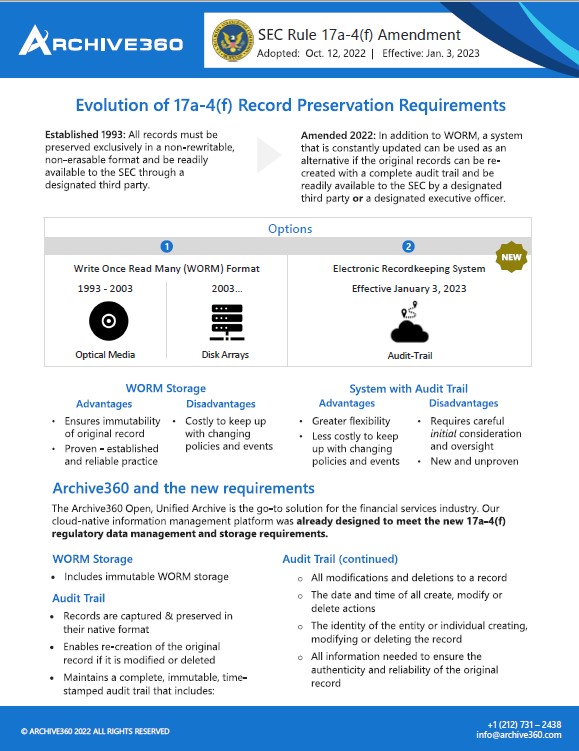
Evolution of 17a-4(f) Record Preservation Requirements
Learn how Archive360's Open, Unified Archive is the go-to solution for the financial services industry. Our information management platform was designed to meet the new regulatory data management and storage requirements.
Archive360 and the new requirements
The Archive360 Open Archiving Solution has long been the go-to solution for the financial services industry, with customers spanning the world’s largest banks and brokerages. Because of how our cloud-native information management platform was designed, our solution already meets the new regulatory data management and storage requirements.
The Archive360 solution stores and manages regulated data in a secure and fully audited environment that guarantees that each record under management is protected from any changes to the original record and can be considered the “copy of record.” If an archived record is exported and updated, it will be archived as a new record, ensuring the original and its metadata are preserved.
Additionally, all activity – sign-ins, mouse clicks, and all other activity is fully audited and reportable. This audit and report data is immutably secured, even from administrators, stored and is a complete log of all activity within the system ensuring compliance with the SEC audit-trail requirements.
For more information on how Archive360 can help your organization, please contact the experts at Archive360 by emailing us at info@archive360.com or calling us at +1 (212) 731-2438.
Bill is the Vice President of Global Compliance for Archive360. Bill brings more than 29 years of experience with multinational corporations and technology start-ups, including 19-plus years in the archiving, information governance, and eDiscovery markets. Bill is a frequent speaker at legal and information governance industry events and has authored numerous eBooks, articles and blogs.