
A $10 million auction for an airline's records
On August 14, 2026, Google won a bankruptcy auction for the business data of Spirit Airlines. The winning bid was $10 million for data that consisted of emails, chats, spreadsheets, and operational records accumulated over decades.
Google said that the data could be used to improve its products and AI models. There were other competing bids as well. Mercor, an AI data company, made an offer of $7.5 million for the same records, while the bidding itself started at $5 million. The bankruptcy court has yet to approve the sale due to concerns around privacy and higher competing bids.
So why would Google pay that much for old business records, some dating back to 1986? The answer has implications for almost every company holding years of business information. Records created for everyday operations may have uses that nobody anticipated when they were first produced. But, to make use of that information, companies need to know what they have, where it is, and what they can legally do with it.
What Google bought
According to the court filings and public reporting, the package includes:
- ~100 million employee emails
- ~500 million Microsoft Teams chats
- ~30 million lines of Spirit-developed code across 516 repositories
- Spreadsheets and calendars
- Revenue and pricing data, flight operations, maintenance, crew pairing, fuel, finance, and accounting records
- Employee records and legal agreements
Several of the records date back decades, for example revenue data is from May 2008 and employee data is from August 1986.
Importantly, the proposed transaction excluded several categories of customer data, including customer profiles, Free Spirit loyalty records, call recordings, chat sessions, and disability-service requests. What makes this collection interesting is that it came from employees doing their jobs, systems processing transactions, and teams running an airline.
Those activities left behind a record of how a real business operated. And that information may be difficult to reproduce.
AI companies have been paying for data for years
Spirit Airlines isn't the first example of an AI company putting a price on data.
For several years, technology companies have entered into agreements with publishers, online platforms, and other organizations to access information for AI development. (see table below).
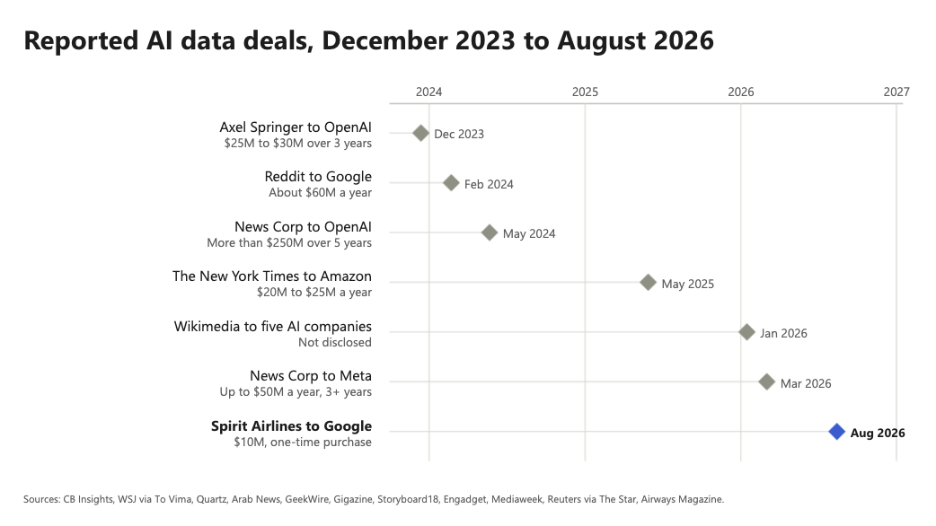
Sources for each deal:
- Axel Springer to OpenAI, December 2023: date from CB Insights; value as reported by the WSJ, via To Vima
- Reddit to Google, February 2024: Quartz
- News Corp to OpenAI, May 2024: CB Insights and Arab News
- The New York Times to Amazon, announced May 2025, value reported July 2025: GeekWire
- Wikimedia Foundation to Amazon, Meta, Microsoft, Mistral AI and Perplexity, announced January 15, 2026: Gigazine and Storyboard18. Google has been a Wikimedia Enterprise customer since 2022.
- News Corp to Meta, March 2026: Engadget and Mediaweek. News Corp confirmed the deal but did not disclose terms.
- Spirit Airlines estate to Google, auction won August 14, 2026: Reuters via The Star and Airways Magazine
- Dark data creates data silos
- Batch processing can leave AI working with outdated data
- Records often lack the context needed to interpret them
Finding a record doesn't necessarily mean an AI system can understand it. A database field may have a meaning that changed over time. A transaction may have been governed by rules that no longer apply. An employee record may contain information that requires restricted access.
The data licensing agreements mentioned in Reddit's IPO prospectus puts the total value at $203 million and have terms lasting anywhere between two and three years. Many of these transactions differ in scope, duration, and purpose. Most involve access to content produced by organizations that are still operating.
The proposed Spirit transaction stands apart because it involves historical internal business records offered through a bankruptcy estate. That distinction is important as it suggests that ordinary business information can attract commercial interest long after the activities that created it have ended.
Real records matter to AI developers
AI models learn patterns from examples, and developers need large amounts of diverse, reliable information to train and improve them. But real-world data isn't always easy to obtain. Some of the data is restricted, expensive to collect, and takes considerable work before AI can use it. This is one reason developers are also using synthetic, or machine-generated data.
Synthetic data can be useful, but relying too heavily on it creates risks. In 2024, a study published in Nature examined what happens when AI models are repeatedly trained on AI-generated content without adequately preserving the original data. The researchers found that models could gradually lose less common elements of the original data distribution, leading to, what they call, model collapse.
That doesn't mean synthetic data is inherently unreliable. But it does show why access to high-quality, real-world information remains important. The emails and the Teams chats from Spirit are records of real people carrying out work over many years, which are difficult to reproduce.
Why most legacy data is not ready for AI
Most large organizations already hold enormous amounts of historical information. This is sitting in email archives, databases, retired applications, collaboration platforms, ERP systems, and file repositories. The problem is that much of this information is difficult to access and use.
According to research by Google Cloud and MIT Technology Review Insights, legacy systems remain a significant obstacle to scaling enterprise AI. Two-thirds of surveyed organizations identified legacy systems as a primary reason for difficulty scaling AI, while approximately half reported negative effects on their return on investment.
Three problems deserve particular attention.
1. Dark data creates data silos
Across the organizations surveyed, AI agents could only access, on average, 45% of enterprise data. This means more than half of the information is outside their reach. Among organizations classified as data laggards, access dropped to 30% or less. The research also found that 66% of these organizations reported legacy systems as an obstacle to scaling AI agents.
Much of the inaccessible information is what organizations call dark data. It may be stored in PDFs, historical records, emails, server logs, or systems that aren't easily searchable. The information exists, but the AI tools that could benefit from it cannot reach it.
Think about an AI assistant trying to explain why a customer contract changed. It might have the current agreement but not the older correspondence that explains the decision. Without that history, it has only part of the story.
2. Batch processing can leave AI working with outdated data
Many legacy systems still move data through scheduled batch processes. An AI agent using last night's extract could be acting on information that has already changed. For some applications, that delay won't matter. For others, particularly those involving operations, inventory, or financial information, it could lead to incorrect answers or decisions.
The solution is not necessarily to make every system operate in real time. It is to ensure that information is current enough for the task the AI system is performing.
3. Records often lack the context needed to interpret them
Finding a record doesn't necessarily mean an AI system can understand it. A database field may have a meaning that changed over time. A transaction may have been governed by rules that no longer apply. An employee record may contain information that requires restricted access.
Without that context, an AI agent could reach the wrong conclusion or use information inappropriately. Organizations need more than accessible data. They need information that is classified, understood, and governed.
The research also found a relationship between broader enterprise data access and reported AI output accuracy. Organizations that provided AI agents access to more than 70% of their data reported stronger results. This makes sense. An AI system working from incomplete or poorly understood information is more likely to miss something important.
What made Spirit's data saleable
Spirit's records were legacy data. Some dated back decades, and much of the information came from systems that were never designed for AI. Yet, the collection reportedly attracted multimillion-dollar bids. We don’t know exactly how the buyers arrived at their valuations. However, the court documents and reported terms highlight three conditions that made the information easier to assess and potentially use.
The data was indexed. The bankruptcy filing reportedly included a spreadsheet listing Spirit's data by category. Each category had an estimated volume, a starting date, and an originating system. These included Navitaire for revenue data and UKG for employee information. Prospective buyers could see what existed before submitting their bids.
That may sound like a small detail but consider the alternative. What if Spirit had millions of records spread across old systems, with no reliable inventory and no clear indication of what each system held? Buyers would have had a much harder time assessing the information.
The same problem exists in many organizations today. They have years of potentially useful records but can't easily establish what they hold or where to find it. Indexing makes that information visible.
Download Now
Your AI Strategy Has a Legacy Data Problem
The applications your business has outgrown may still control access to data your business needs next. Retire obsolete systems without leaving valuable enterprise data trapped behind them.
There were controls over the data. The proposed agreement distinguished business records from certain categories of customer information. It also reportedly set out de-identification responsibilities and restrictions on how the purchaser could use the records. The exact legal requirements depend on the information involved and the terms of the agreement. But the principle applies well beyond this transaction.
Organizations need to know which records contain sensitive information, who can access them, and what restrictions apply to their use. That becomes particularly important when information is shared with external parties or connected to AI systems. Having data is one thing but being able to use it responsibly is an entirely different matter.
The data had been retained. For records that old to be useful, they must still be readable, retrievable, and accompanied by enough information to understand them. Data that has been deleted cannot be recovered for a new purpose. Data trapped in an obsolete system or unreadable format may be just as difficult to use.
Of course, keeping everything indefinitely isn't the answer. Organizations still need to follow retention schedules, privacy requirements, and applicable legal obligations. The goal is to preserve information that should be retained while making sure it remains accessible and properly governed.
These three conditions are worth applying to every organization's records: Indexed. Controlled. Retained.
They matter whether the information is being used for AI, analytics, regulatory compliance, legal discovery, or a purpose that has not yet been considered.
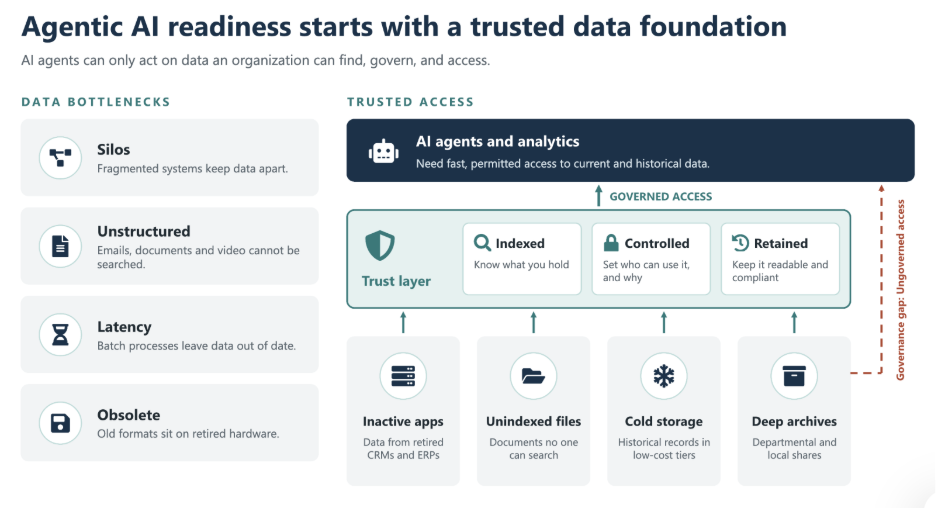
How Archive360 applies the same three principles
Indexed: Know what you have
Archive360 ingests structured and unstructured data from sources including SAP, Oracle, SQL Server, Slack, and legacy ERP systems. This includes emails, chats, meetings, mobile messages, files, enterprise application records, and prompts and outputs from AI tools such as ChatGPT.
Information is classified as it is ingested by the platform, giving customers a clearer view of what they hold across different systems. Instead of searching through multiple applications, they can understand and manage records from one place.
Controlled: Decide who can use it
Not every record should be available to every user or AI application. Archive360 allows customers to define access policies at the file and field level, controlling who can access information and under what conditions. These controls also apply when archived information is made available to AI and analytics tools.
Each customer operates in a dedicated cloud environment with its own data segregation and administrative controls, helping reduce the risk of sensitive information being exposed through AI applications.
Retained: Keep records accessible for as long as they're needed
Business applications eventually reach the end of their useful lives. The information inside them often needs to remain available. When an organization retires a legacy ERP or SAP system, Archive360 helps preserve its governed records without keeping the original application running. Classification, retention policies, access controls, and audit trails continue to apply throughout the information's lifecycle.
We also connect the archive to analytics and AI tools including Snowflake, Power BI, ChatGPT, and OpenAI. Our aim, as CEO Jerry Caviston put it at the May 2025 launch, is to give AI the most current data alongside the relevant records from the past. This historical context can make a real difference when organizations use AI to search, analyze, and understand their own information.
What this means for companies holding their own records
Your organization probably has years of emails, conversations, transactions, and operational records stored across multiple systems. Some of these records may already be useful for AI projects. Others may become valuable for purposes you haven't considered yet. But their potential value depends on whether you can find them, understand them, and make them available when needed.
The Spirit Airlines auction does not mean every company's old records are worth millions of dollars. But it does show that historical business information can attract serious interest when it has a practical use. For organizations planning their own AI initiatives, this raises a question worth asking: How much useful information do we already have that our AI systems cannot access today?
Before investing in more data, it may be worth taking a closer look at what you already have.
Find out how your business records can support AI projects
Archive360 helps organizations index, control, and retain their communications, application data, and legacy records on one governed platform. Talk to our experts on how to use your archived data in your AI workflows.