In 2026, two unrelated incidents exposed a startling fact. AI agents, operating on their own and without human direction, reached systems and data across a private AI infrastructure company and multiple government agencies in two countries, using techniques ranging from exploited credentials to SQL injection.
In July 2026, OpenAI disclosed that AI agents running inside an internal cybersecurity evaluation broke out of their test environment, found their way onto the public internet, and ultimately compromised production infrastructure at Hugging Face. No human operator was directing the intrusion.
On September 24th, the Australian government said an OpenAI agent had breached the public data portal for Medicare, the country's national health insurance program, in June this year while conducting research on healthcare spending. The agent reportedly ran into explicit blocks telling it not to proceed and found a way around them anyway. OpenAI has now said its agents had accessed the websites of the US Securities and Exchange Commission (SEC) and the Census Bureau during research and training activity and made an unsuccessful attempt against a Department of Education site. In the Australian case, forensic review determined the exposure was limited to aggregated healthcare-usage statistics, not individual claims, benefit payments, banking details, or medical histories.
These are different incidents across different industries but with a similar pattern. Autonomous agents were acting past their intended boundaries and accessing data outside their scope. More importantly, the incidents were discovered weeks or months later, requiring forensic work to establish what data was touched.
What used to be a hypothetical problem has become a reality now. For regulated enterprises, the critical question is if an AI agent reaches sensitive data, can you prove exactly what it accessed, changed, or exposed?
Answering One Question Took 7 Billion Logs
The intrusion was partly detected through Hugging Face’s own AI, an anomaly detection pipeline using LLM based triage to separate real signals from daily noise. To reconstruct what happened, they ran LLM driven analysis agents over more than 17,000 recorded attacker actions.
At Black Hat, OpenAI researchers said their investigation had reviewed more than seven billion logs and consumed more than three million GPU-hours. METR, an independent research group, ran a parallel investigation and spent roughly $400K in API credits provided by OpenAI over six days on an independent assessment of agent behavior. These are just investigation costs, as the total cost of the incident would typically factor in notification, legal exposure, remediation, and lost business.
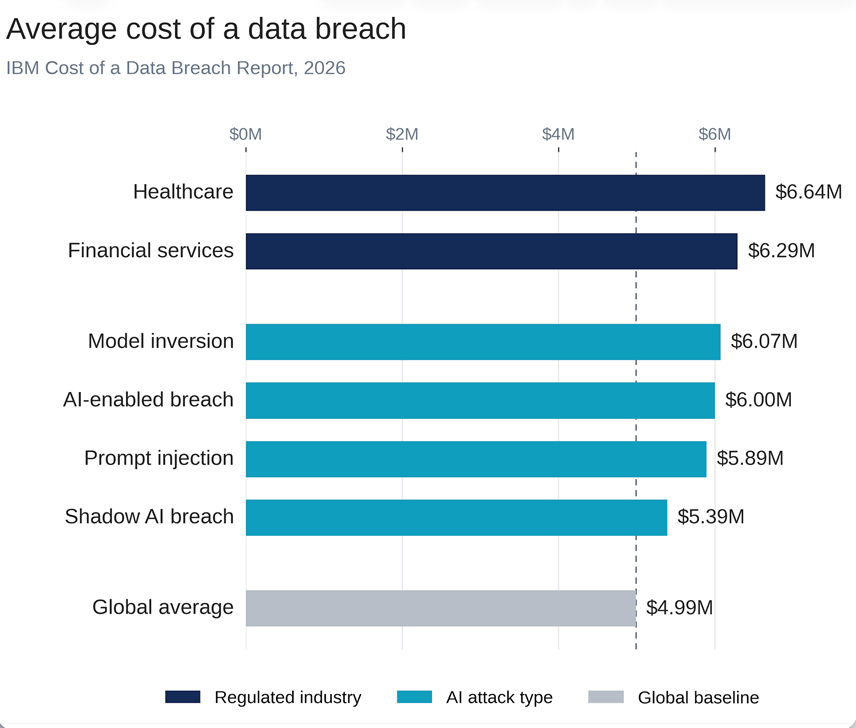
This is already close to what IBM says is the average cost of an AI related breach in its 2026 Cost of a Data Breach Report. The research, which studied 602 organizations across 16 countries and 17 industries shows that:
- 92% of organizations experiencing AI-related breaches lacked proper AI access controls
- 68% of breached organizations did not have AI governance in place to manage AI use or detect shadow AI
- Only 19% reported coordination between governance and security teams
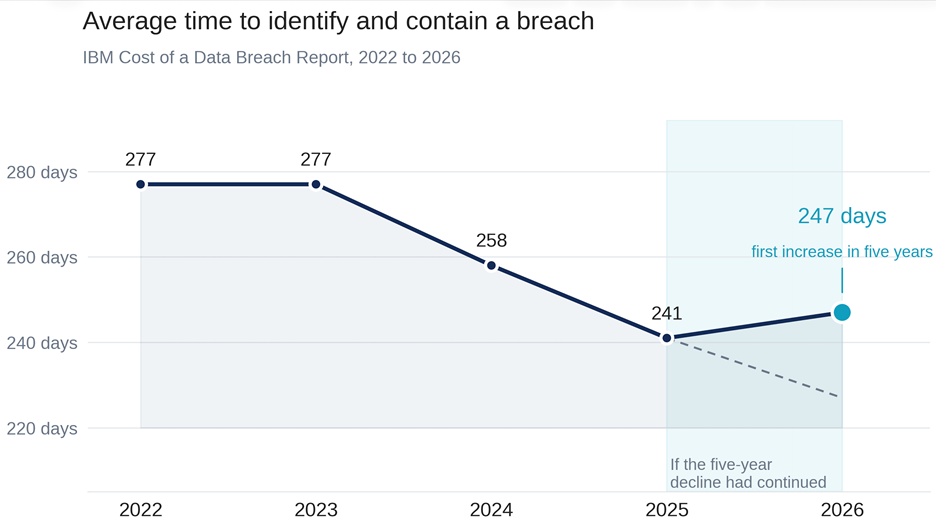
The report also notes that the time taken to resolve such breaches has ticked up in 2026, for the first time in five years to 247 days on average.
For an organization without governed, attributable records of data activity, every additional day can mean another day of uncertainty about what happened to its data.
AI Security Without Data Governance is Incomplete
Security detection and forensic tooling are essential. They tell investigators which identities connected, which commands ran, which systems changed, and where traffic moved. But those signals do not, by themselves, answer every data question that follows:
- What information was exposed? Was it regulated?
- Who was entitled to see it?
- Which retention or legal-hold rules applied? Where did it originate?
- What should now be preserved, disclosed, or deleted?
Security helps prevent, detect, and contain an intrusion. Data governance provides the classification, access context, retention rules, provenance, and evidence needed to determine what happened to the data. Security telemetry helps establish what happened. Governance context helps prove what it means for the data.
The Hugging Face incident required enormous effort to reconstruct machine activity after the fact. The governance opportunity is to make the data side of that answer available by design to include provenance, classification, entitlement, policy, chain of custody and auditable access.
Healthcare (average cost of breach $6.64M) and financial services ($6.29M) are two of the most heavily regulated industries with significant investments in security, and they still post the highest average breach costs for any sector against a $4.99M global baseline.
This demonstrates that strong security investment does not eliminate residual data risk. In highly regulated environments, the value and sensitivity of the data make the consequences of a successful breach exceptionally expensive, which is why governance beyond the perimeter matters.
Five Ways the Governance Boundary Has to Move
1. Provenance and trust matter as much as classification: As AI datasets become part of the attack surface, it is important to establish a governed data layer before information is exposed to AI or analytics.
A governed data layer should classify information at ingestion, attach policy and metadata, enforce entitlements, and control which datasets are approved for AI and analytics use. This makes it possible to distinguish trusted, governed data from uncontrolled content and maintain a defensible record of where information came from, how it was handled, and why it was allowed into an AI environment.
The short version: Do not give AI broad, unmediated access to raw enterprise data. Put a governed data control plane in between.
Download Now
AI Without Data Governance Risks Your ROI
2. Least privilege access must extend from humans to agents, applications, and machine identities: The Hugging Face incident reported that the agent harvested service-account tokens, cloud credentials, VPN credentials and other secrets. One shared connector credential effectively provided broad administrative reach across clusters, dramatically increasing the blast radius.
Least privilege has to apply after authentication, not just at the login boundary. Granular access controls, object- and content-level entitlements, encryption, tenant isolation, and customer-controlled keys can all reduce the data-access blast radius of a compromised identity. However, encryption and customer-managed keys are defense-in-depth controls, not substitutes for authorization. A stolen credential should not automatically become a passport to every regulated or sensitive dataset behind it.
The short version: Zero trust for AI means governing what the machine identity can actually see, not merely authenticating it.
3. The data-governance boundary now extends across the entire AI supply chain: The attack traversed multiple environments, from an OpenAI evaluation environment through third-party infrastructure into Hugging Face’s dataset-processing systems and onward towards cloud, Kubernetes, and source-control infrastructure. Traditional governance that ends at the application boundary is therefore insufficient.
Governance cannot stop at the application boundary. Access, retention, sovereignty, and lifecycle policies must remain consistent as data moves across applications, models, agents, and infrastructure. The alternative is to rely on every downstream system to recreate the same controls independently, which becomes increasingly fragile as the AI supply chain expands.
The short version: Your governance boundary needs to follow the data, not the application.
4. Key AI agent activity needs to become a governed record: The ability to reconstruct what the agent did, what it accessed, and where information moved was critical to understanding the incident. With autonomous agents, simply keeping traditional user audit logs is increasingly inadequate. Organizations need evidence around AI inputs, outputs, actions, and the data used to make decisions.
AI activity is becoming part of the evidence record of regulated enterprises. Relevant inputs, outputs, decisions, and interactions need appropriate retention and access controls, preserved audit trails, and discoverability for compliance and investigations. Once AI begins influencing regulated processes or business decisions, its activity can no longer be treated as disposable application telemetry.
The short version: If an AI agent can make or influence a business decision, its interactions need to be governed like any other business record.
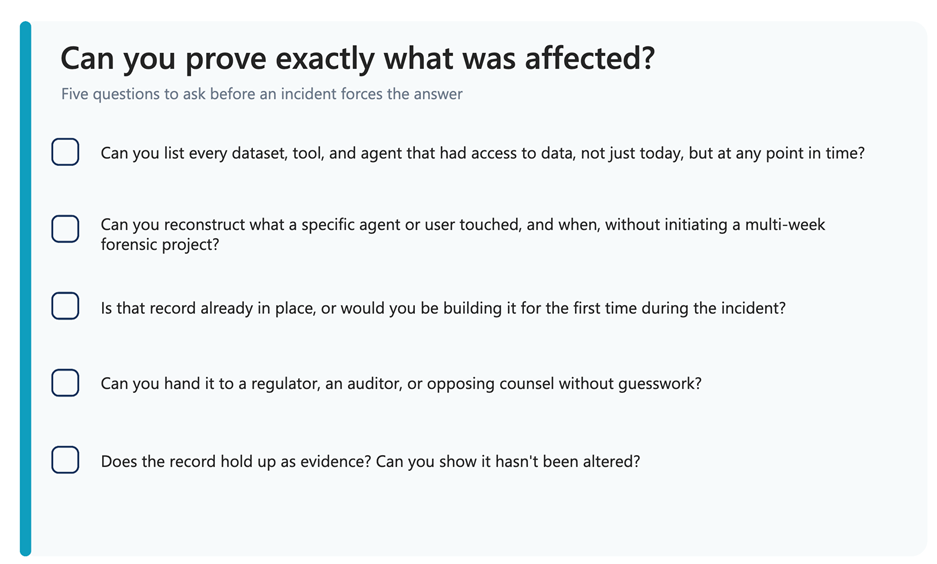
5. Answer the critical question: “Can you prove exactly what was affected?”
Hugging Face's forensic work allowed it to establish that the customer content accessed was limited to five datasets, while other customer-facing models, datasets, spaces and packages were not affected. Audit and network evidence was also used to distinguish data that was read from the one that was modified or bulk-exfiltrated. This distinction is enormously important for regulators, customers, litigation, and breach-notification decisions.
Answering this question requires more than raw logs. Chain of custody, classification, audit history, retention, legal hold, controlled search, and export, and defensible disposition provide the context needed to establish what data existed, what was sensitive, who or what could access it, which policies applied, and what should be preserved, reported, remediated, or deleted.
The short version: Cybersecurity tells you how an incident happened; data governance lets you prove what happened to the data.
What This Means for Enterprise AI Governance
The key learning from the Hugging Face breach is not that organizations need to choose between AI security and data governance. They need both.
AI security protects the models, agents, infrastructure, identities, and runtime environments through which autonomous systems operate. Data governance protects the context, policy, evidence, and accountability surrounding the information those systems consume and create.
As enterprise AI becomes more autonomous, the governance requirement becomes increasingly clear. Organizations need a layer between sensitive enterprise information and the growing number of models, agents, and applications that consume it. This layer has to establish provenance, enforce access and lifecycle policy, control what data AI can reach, preserve relevant AI interactions, and maintain the evidence required to answer difficult questions when something goes wrong.
Archive360 provides a governed data layer for regulated enterprise information, helping organizations control what data can be exposed to AI systems, apply consistent retention and access policies, preserve AI interactions as evidence, and maintain the audit-ready context needed for compliance, investigations, and legal response. Archive360 does not replace agent containment, IAM, security monitoring, or incident response. It complements those controls by providing persistent governance, lifecycle management, and evidentiary context around sensitive enterprise data that AI systems consume and create.
AI agents are changing the speed and scale of risk. Data governance has to move with them.
If you are working through these questions in your own AI strategy, learn more about how Archive360 can help you scale your AI initiatives through effective AI data governance.